Many people wonder whether common law marriage is the same as a legal marriage. The answer is yes and no. Once a valid common law marriage is established in a state that recognizes it, it generally has the same legal status as a traditional (ceremonial) marriage. However, the way each type of marriage is created is very different.
Understanding the differences can help couples know their legal rights, responsibilities, and whether they need a marriage license or formal ceremony.
This guide compares common law marriage vs. legal marriage, explains their similarities and differences, and answers common questions.
Quick Comparison
| Feature | Common Law Marriage | Legal (Ceremonial) Marriage |
| Marriage license required | Usually No* | Yes |
| Wedding ceremony required | No | Yes |
| Recognized in all states | No | Yes |
| Available in every state | No | Yes |
| Legal rights after marriage | Same as ceremonial marriage (if valid) | Full legal rights |
| Divorce required to end marriage | Yes | Yes |
*Utah requires court recognition, while Texas allows an optional Declaration of Informal Marriage.
What Is a Common Law Marriage?
A common law marriage is a legally recognized marriage that is created without a formal wedding ceremony or marriage license in states that allow it.
Instead, the couple generally must meet specific legal requirements, such as:
- Being legally eligible to marry
- Intending to be married
- Living together (in many states)
- Publicly presenting themselves as spouses
Not every state recognizes new common law marriages.
What Is a Legal Marriage?
A legal marriage, also called a ceremonial marriage, is the traditional way most couples get married.
It usually requires:
- Obtaining a marriage license
- Meeting state eligibility requirements
- Having an authorized officiant perform the ceremony
- Completing and filing the marriage certificate
Once these steps are completed, the marriage is legally recognized nationwide.
Common Law Marriage vs. Legal Marriage
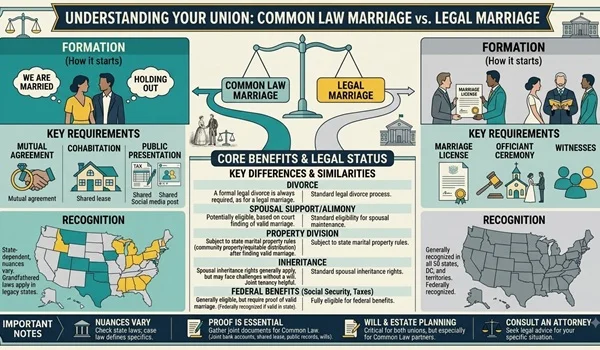
- Marriage License
Common Law Marriage
Most states that recognize common law marriage do not require a marriage license. However, some states have unique rules. For example, Texas allows couples to voluntarily file a Declaration of Informal Marriage, while Utah requires court recognition.
Legal Marriage
A marriage license is required before the wedding ceremony.
- Wedding Ceremony
Common Law Marriage
No formal wedding ceremony is required.
Legal Marriage
A ceremony is generally required and must be performed according to state law.
- State Recognition
Common Law Marriage
Only a limited number of states recognize new common law marriages.
Legal Marriage
All 50 states recognize ceremonial marriages that are legally performed.
- How the Marriage Is Proven
Common Law Marriage
Evidence may include:
- Joint bank accounts
- Joint tax returns
- Property ownership
- Insurance policies
- Testimony from friends and family
- Documents showing the couple presented themselves as married
Legal Marriage
A marriage certificate is usually sufficient proof.
- Legal Rights
Once a common law marriage is legally established, spouses generally receive the same legal rights as couples in a ceremonial marriage.
These rights may include:
- Property rights
- Inheritance rights
- Health care decision-making
- Retirement benefits
- Tax benefits, where applicable
- Divorce protections
- Ending the Marriage
Both common law marriages and ceremonial marriages generally require a formal divorce if the marriage is legally valid.
Simply separating does not end either type of marriage.
Similarities Between Common Law Marriage and Legal Marriage
Both types of marriage generally provide:
- Legal recognition
- Property rights
- Inheritance rights
- Spousal benefits
- Divorce protections
- Child-related legal rights
- Court protection during separation or divorce
Once legally recognized, there is usually no legal difference between the rights of spouses in a common law marriage and those in a ceremonial marriage.
Key Differences
| Feature | Common Law Marriage | Legal Marriage |
| Created without ceremony | Yes | No |
| Marriage certificate issued immediately | Usually No | Yes |
| Available nationwide | No | Yes |
| May require proof in court | Yes | Rarely |
| Easier to prove | No | Yes |
Which States Recognize Common Law Marriage?
As of 2026, only a limited number of U.S. jurisdictions recognize new common law marriages:
- Colorado
- Iowa
- Kansas
- Montana
- Oklahoma (limited circumstances)
- Rhode Island
- Texas
- Utah
- District of Columbia
Most other states do not allow couples to create a new common law marriage but may recognize one that was legally established elsewhere.
Advantages of Common Law Marriage
- No formal wedding ceremony required
- No marriage license required in most recognizing states
- Same legal protections once established
- May benefit couples who never had a formal ceremony
Advantages of Legal Marriage
- Easier to prove with a marriage certificate
- Recognized in every state
- Fewer disputes about marital status
- Simpler process for government agencies, employers, and financial institutions
Common Misconceptions
Myth: Common law marriage is not legally valid.
False. In states that recognize it, a valid common law marriage has the same legal status as a ceremonial marriage.
Myth: Living together automatically creates a common law marriage.
False. Living together alone is never enough.
Myth: Common law spouses do not need a divorce.
False. If the marriage is legally valid, a divorce is generally required.
Myth: Every state recognizes common law marriage.
False. Most states no longer allow new common law marriages.
Frequently Asked Questions
Is common law marriage legally the same as a traditional marriage?
Yes. Once a valid common law marriage is established, it generally has the same legal rights and responsibilities as a ceremonial marriage.
Is a marriage license required for a common law marriage?
Usually no, although some states have special procedures. Utah requires court recognition, and Texas allows an optional Declaration of Informal Marriage.
Which is easier to prove?
A legal marriage is generally easier to prove because couples receive an official marriage certificate.
Can common law spouses get divorced?
Yes. If the marriage is legally valid, it generally must be dissolved through a formal divorce.
Is common law marriage recognized in every state?
No. Only a small number of states recognize new common law marriages.
Which type of marriage offers more legal rights?
Once legally established, both generally provide the same legal rights and protections.
Final Thoughts
The biggest difference between common law marriage and legal marriage is how the marriage is created, not the legal rights that follow. A ceremonial marriage requires a marriage license and wedding ceremony, while a common law marriage is established by meeting specific legal requirements in states that recognize it. Once a common law marriage is legally valid, it generally carries the same rights and responsibilities as a traditional marriage, including property rights, inheritance rights, and the requirement to obtain a divorce if the relationship ends.